How to prepare a sculpture or figurine for shipping
A figurine with an outstretched arm may take weight through its base while the arm needs clear space all around. Before wrapping it, identify the parts that carry weight and those that even slight pressure could damage.
Go to the packing steps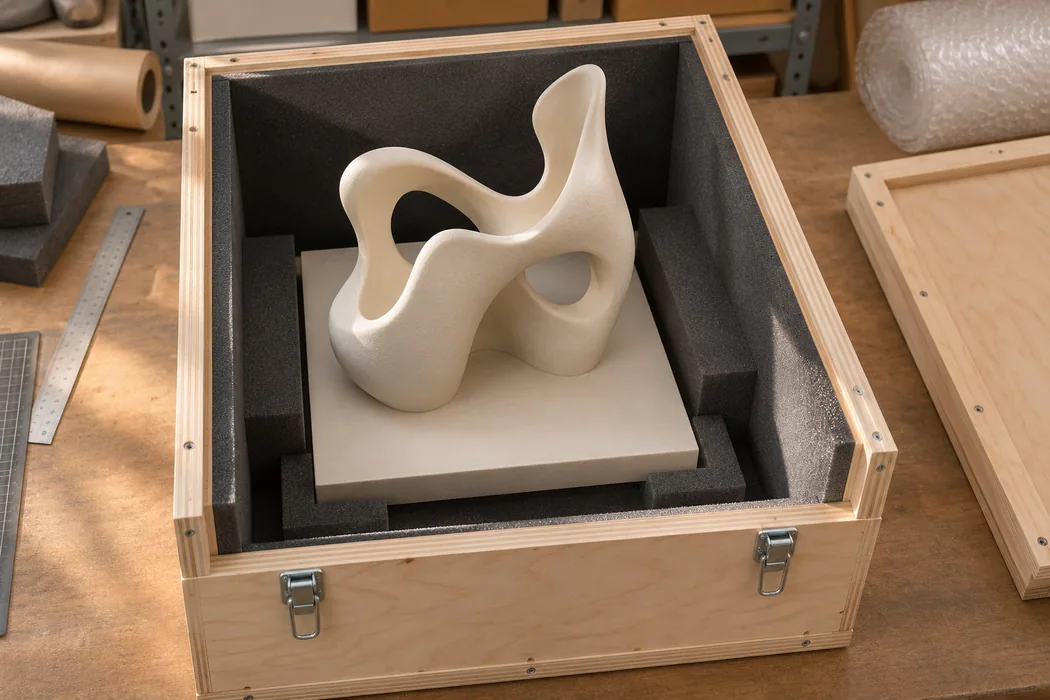
How to pack your parcel
Identify the vulnerable points
Photograph every side and the base. Measure to the outermost projection and record the weight if you know it. A side view helps reveal the thinnest parts.
Identify the support points
For a small, stable piece, select supports that follow the base and stronger areas. Allow space around handles, fingers, beaks and other projections, including when the box tilts.
Leave clearance around openings
Look at the gap between a torso and an arm, or inside a vase handle. Paper forced into a narrow opening can act as a wedge and load the ends. Place the supports against strong outer areas and leave thin features clear.
Separate removable pieces
If a part is designed to come off, photograph its position and prepare a separate recess for it. Leave glued or permanently fixed parts in place.
Plan how the piece will be unpacked
Photograph the orientation and the position of the supports. If the upper support lifts off in only one direction, note it. The recipient should be able to remove supports individually and lift from the base without levering against fingers, petals or other projections.
Choose a box or a crate
Compare the sculpture's dimensions and weight with the capacity of its container. If it is top-heavy, has a heavy base or has a delicate finish, show us photographs so we can assess custom supports and a crate.
Worked example: a ceramic figurine with a raised arm
Photograph the side that shows the arm and measure both the height from the base to the fingers and the overall width. Allow clear space around the face and fingers. Assess the plinth's stability and the body's stronger areas first.
If the base is flat and sound, the workshop can assess a cradle that supports it from below and restrains it from the sides. If the plinth has been repaired or the figure rocks at rest, tell us before selecting packaging. Send a rear photograph too: it may reveal a joint hidden from the front.
Checks before sealing
- Visually trace the load path from the sculpture into the container base. A slender detail or delicate finish must not become a point that carries the work's weight.
- Check that the supports can be removed without dragging them across the finish. For a valuable sculpture, keep the photographs, measurements and material description for the quote and any cover you request.
Troubleshooting
A wide box may still let the padding press on the highest point. Increase clearance to the lid or change the design. Spare room at the sides does not protect a feature that touches the top.